
If your textile products are sold in North America, you’ve likely encountered the requirement for AATCC 183 testing. This standard is the benchmark for measuring UV protection in fabrics, and compliance isn’t optional if you’re making sun-protective claims. The ChiuVention AATCC 183 UV Tester was built specifically to help textile manufacturers, brand owners, and testing laboratories meet this requirement with confidence. Unlike general-purpose instruments that approximate the method, this tester follows the standard’s exact specifications—from the spectral range to the weighting calculations to the reporting format. For compliance testing, that fidelity matters enormously. When a customer asks to see your test data, or when a regulator reviews your product claims, you need to be able to demonstrate that your testing followed the official method, not a close-enough interpretation. The ChiuVention system gives you that certainty, removing the anxiety that comes with wondering whether your results would hold up under scrutiny.
What AATCC 183 Compliance Actually Requires
Let me walk you through what the standard demands, because many people underestimate its specificity. AATCC 183 requires that UV transmittance be measured across the range of 280 to 400 nanometers, with a spectral bandwidth of 5 nanometers or less. The instrument must use a light source that simulates natural sunlight, typically a xenon arc lamp. The detector must be capable of measuring transmittance accurately across a wide dynamic range. The calculation of UPF must apply the CIE erythemal action spectrum, which weights each wavelength according to its potential to cause skin reddening. Multiple specimens from each fabric sample must be tested, and the results averaged. The final UPF value must be rounded according to specific rules. The ChiuVention AATCC 183 UV Tester meets each of these requirements precisely. The software is pre-configured to apply the correct weighting and rounding. The sample handling follows the standard’s recommendations. When you run a test, you know you’re running the method as written.
How the ChiuVention Tester Implements the Standard
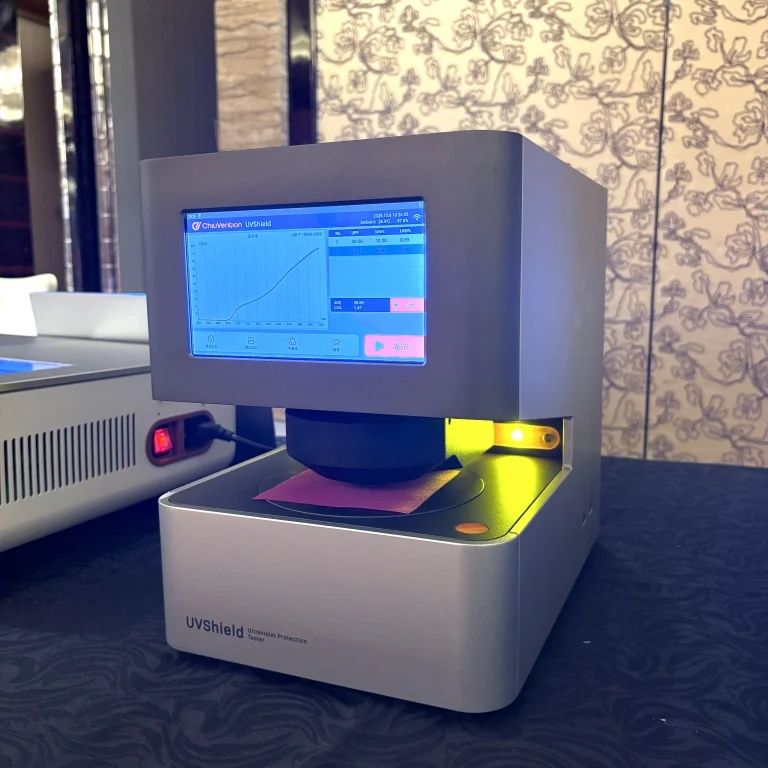
Moving from the standard’s text to actual operation, the ChiuVention system makes compliance straightforward. You begin by conditioning your fabric samples in the required atmosphere—the tester records temperature and humidity to document conditions. You then place the sample in the holder, which applies consistent pressure without stretching or distorting the fabric. The instrument automatically performs a spectral scan, measuring transmittance at each wavelength. The software then applies the erythemal weighting, calculates the UPF, and rounds the result according to AATCC 183 rules. But the implementation goes deeper. The tester also checks for variability between specimens. If your five specimens produce significantly different results, the system flags this, just as the standard suggests. If the calculated UPF falls near a classification boundary, the software notes this in the report. These aren’t afterthoughts. They’re deliberate implementations of the standard’s guidance, saving you from having to manually check these conditions yourself.
Benefits for Certification and Market Access
Why go through the trouble of AATCC 183 compliance? The answer is market access. Major retailers in North America increasingly require certified test data before they will stock sun-protective clothing. Online marketplaces like Amazon have been known to request verification of UPF claims. And if your product ever faces a legal challenge regarding its UV protection, having AATCC 183 test results on file is your best defense. The ChiuVention tester supports all of this by generating reports that include everything an auditor or customer might want to see: spectral data, specimen-by-specimen results, environmental conditions, operator identification, date and time stamps, and a clear statement that testing followed AATCC 183. You can brand these reports with your laboratory’s name and logo, presenting a professional image to clients and regulators. For textile businesses serious about the North American market, this certification capability isn’t a luxury—it’s a requirement.
Integrating Compliance Testing Into Your Workflow
One concern I often hear from quality managers is that adding compliance testing will slow down their operations. The ChiuVention AATCC 183 tester is designed to integrate smoothly into existing workflows. The instrument is compact enough for most lab benches. The software interface is intuitive, so technicians don’t need extensive retraining. Test protocols can be saved and reused, eliminating the need to re-enter settings for each fabric type. Results are automatically stored and can be exported to your quality management system. For manufacturers who previously outsourced all AATCC 183 testing, bringing it in-house actually speeds up their workflow dramatically. Instead of waiting weeks for external lab results, you have answers within minutes. You can test prototypes, adjust formulations, and retest immediately. This agility is a competitive advantage that more than justifies the equipment investment.
Common Pitfalls in AATCC 183 Testing and How to Avoid Them
Even with good equipment, there are common mistakes that can compromise AATCC 183 compliance. One frequent error is testing fabrics that haven’t been properly conditioned. The standard specifies conditioning in a standard atmosphere, and skipping this step can alter results. The ChiuVention software prompts you to record conditioning time and conditions, helping you avoid this oversight. Another pitfall is testing too few specimens. The standard recommends at least five, but busy labs sometimes cut corners. The tester enforces this by requiring a minimum number of replicates before calculating an average. A third issue is using incorrect rounding. The software handles rounding automatically, eliminating a surprising source of errors. Finally, some labs fail to document their procedures adequately. The ChiuVention system maintains a complete audit trail, so when an auditor asks how you tested, you have the answer ready.
Building Long-Term Compliance Capability
Investing in AATCC 183 testing equipment isn’t just about passing today’s compliance checks. It’s about building a long-term capability that grows with your business. The ChiuVention tester receives software updates that keep pace with revisions to the standard. When AATCC releases a new version of 183, you won’t be left with obsolete procedures. The instrument’s calibration can be traced to national standards, maintaining your accreditation eligibility year after year. And because you own the capability, you can test as often as you like without watching per-sample costs add up. For textile companies that take UV protection seriously, this long-term perspective changes the equation. The upfront investment in AATCC 183 compliance testing pays dividends not just in avoided fines or rejected shipments, but in faster product development, stronger customer trust, and the ability to move quickly when opportunities arise. That’s the real value of being compliant, not just checking a box.